
You have an idea for a revolutionary AI voicebot. It’s an intelligent, conversational agent that will streamline your customer service, personalize your user experience, and provide 24/7 support. As you and your development team dive into the exciting world of AI models and conversational design, there is a silent and often overlooked partner in your project that demands your attention from day one: your legal and compliance team.
In the world of voice AI, “compliance” is not a box you can check at the end of a project. It is a foundational, architectural, and legal requirement that must be woven into the very fabric of your application. A failure to understand and adhere to the complex web of regulations that govern voice communication and data privacy can have catastrophic consequences for your business, ranging from multi-million dollar fines to a complete loss of customer trust.
This guide is designed to be a primer for the builder, the developer, and the business leader. We will provide a high-level overview of the core compliance basics that you must be aware of when building any AI voicebot. This is your essential “pre-flight checklist” for navigating the complex but navigable world of voice AI compliance.
Table of contents
Why is Compliance a “First Principle” of Voice AI?
For any application that handles customer data, compliance is important. For a voice application, it is an absolute, non-negotiable first principle. A voice conversation is one of the most data-rich and sensitive interactions you can have. It involves not just what is said, but how it is said, the biometric signature of a person’s voice. This makes the stakes of data privacy and consent incredibly high.
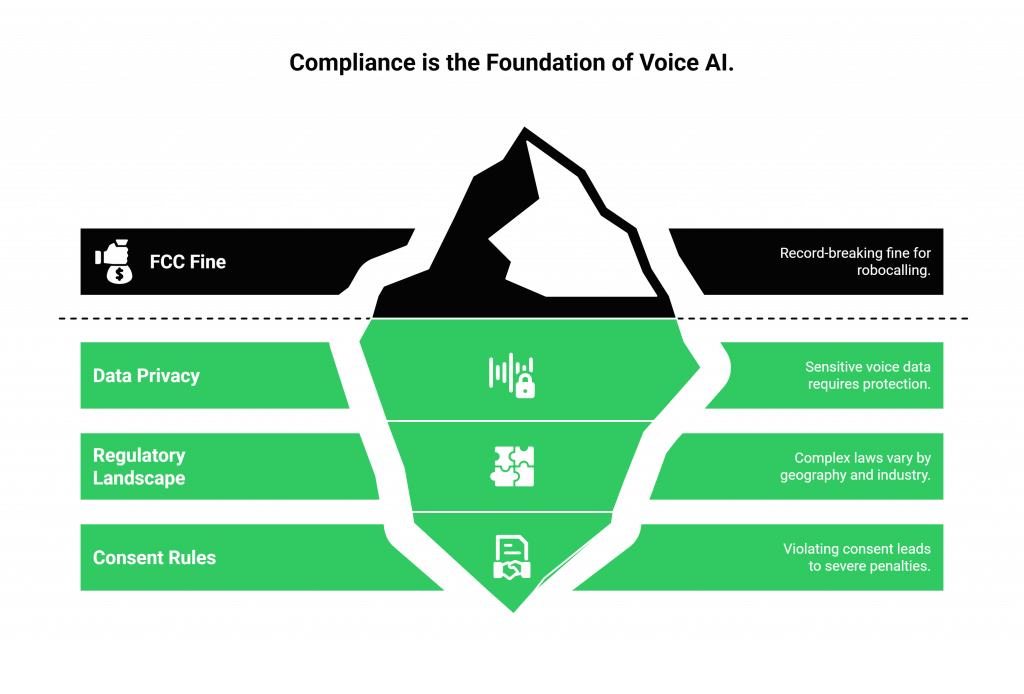
The regulatory landscape is a complex patchwork of laws that vary by geography and industry. A single call could be subject to multiple, overlapping regulations. The cost of getting this wrong is not just a theoretical risk.
In 2023, the Federal Communications Commission (FCC) issued a record-breaking nearly $300 million fine against a robocalling operation for violating consent rules, a stark reminder of how seriously regulators are taking these issues.
What are the Core Pillars of Voice AI Compliance?
While the specific regulations can be complex, they are all built on a foundation of a few core, common-sense principles. Your AI voicebot architecture must be designed to uphold these principles at all times.
Pillar 1: How Do You Handle Consent and Disclosure?
This is the principle of transparency. You must be clear and upfront with your users about what is happening on the call.
- Call Recording Notification: In many jurisdictions (with laws varying by state and country), you’re legally required to inform all parties that a call is being recorded. Your AI voicebot should play a clear, unambiguous disclosure at the start of every call (e.g., “This call may be recorded for quality and training purposes.”).
- Consent for Automated Calls (TCPA): In the United States, the Telephone Consumer Protection Act (TCPA) places strict limits on making automated, outbound calls. For most informational calls, you must have the user’s “prior express consent” to contact them. For telemarketing calls, the standard is even higher.
Pillar 2: How Do You Ensure Data Privacy and Security?
This is the principle of protection. You have a fundamental duty to protect the sensitive data that is shared on a call. This requires a “security-first” architecture. A secure voice infrastructure like FreJun AI is the essential foundation, providing the encrypted channels and secure protocols that are the prerequisites for a compliant application.
- End-to-End Encryption: All audio data must be encrypted, both in transit (using SRTP/TLS) and at rest.
- Data Minimization: Your system should only collect and store the absolute minimum amount of data necessary. This includes having a clear data retention policy and automatically redacting sensitive PII from logs.
Also Read: How Do Voicebots Help Reduce Wait Times?
Pillar 3: How Do You Uphold Industry-Specific Regulations?
For many businesses, there is an additional layer of industry-specific rules that must be followed.
| Industry Vertical | Key Regulation(s) | Core Requirement for a Voice AI |
| Finance | PCI DSS (Payment Card Industry Data Security Standard) | To never store, process, or transmit sensitive cardholder data in an insecure way. The AI must use secure DTMF capture for payments. |
| Healthcare | HIPAA (Health Insurance Portability and Accountability Act) | To protect all Protected Health Information (PHI). All vendors in the data chain must sign a Business Associate Agreement (BAA). |
| Global | GDPR (General Data Protection Regulation) in Europe | To uphold a user’s “right to be forgotten” and other strong data privacy rights. Requires a clear legal basis for processing any personal data. |
What is the Architectural Blueprint for a Compliant AI Voicebot?
Compliance is not just a legal issue; it is an engineering challenge. Your application’s architecture must be designed from the ground up to meet these requirements.
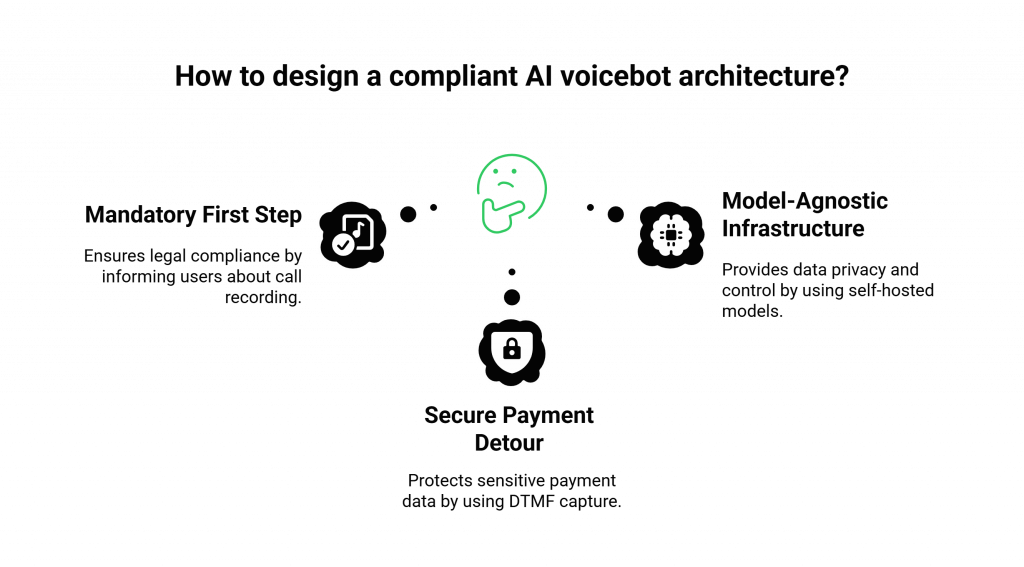
How Do You Build a “Compliance-by-Design” Call Flow?
Your bot’s conversational logic must have compliance built into its very structure.
- The Mandatory First Step: The very first action in any inbound call flow must be the call recording disclosure. This cannot be skipped.
- The Secure “Detour” for Payments: When a user needs to make a payment, the conversation must be programmatically “detoured.” The AI should stop the standard conversational flow and hand off to a secure DTMF (keypad tone) capture mode.
A powerful voice infrastructure like FreJun AI can manage this secure capture, ensuring the sensitive numbers never touch your AI models or your call recordings.
Also Read: How Do Voice APIs Power Next-Gen AI Systems?
Why is a Model-Agnostic Infrastructure a Compliance Advantage?
For businesses with the strictest data privacy requirements, the ability to control the AI “brain” is a major advantage. A model-agnostic voice infrastructure, such as FreJun Teler, is crucial here.
Teler gives you the freedom to use a private, self-hosted open-source model. This means that your customers’ sensitive conversational data never has to be sent to a third-party AI provider, giving you an unparalleled level of data privacy and control.
Ready to build a voice AI on a secure and compliant foundation? Sign up for a FreJun AI!
What is Your “Pre-Launch” Compliance Checklist?
Before you launch any AI voicebot to the public, you must go through this final checklist with your legal and technical teams.
- Have we consulted with legal counsel? You must have a legal expert review your call flows and data handling practices to ensure they comply with all relevant federal, state, and international laws.
- Is our call recording disclosure clear and immediate?
- Do we have the proper consent for any outbound calling campaigns?
- Is all our voice data encrypted, both in transit and at rest?
- Have we signed a Business Associate Agreement (BAA) with all our vendors (including our voice provider) if we handle PHI?
- Are we using secure DTMF capture for all payment information?
- Do we have a clear data retention and deletion policy?
Also Read: The Rise of Multimodal AI Agents Explained
Conclusion
Building an AI voicebot is an incredibly exciting journey into the future of customer communication. But this innovation comes with a profound responsibility. The rules that govern consent, data privacy, and security are not optional guidelines; they are the bedrock of a trustworthy customer relationship.
By making compliance a “first principle” of your design, by architecting your application with security at its core, and by partnering with an infrastructure provider that shares your uncompromising commitment to these standards, you can innovate with confidence.
You can build an AI voicebot that is not just intelligent and efficient but also a trusted and responsible guardian of your customers’ data.
Want to discuss how our security architecture can help you meet your specific compliance needs? Schedule a demo for FreJun Teler!
Also Read: 919 Area Code: Where Is It and What Country Uses It?
Frequently Asked Questions (FAQs)
While it depends on your industry, the most universal and critical issues are consent and disclosure. This includes informing users that a call is being recorded and having the proper consent to contact them with an automated system.
The TCPA (Telephone Consumer Protection Act) is a US federal law that places restrictions on the use of automated dialing systems and artificial or prerecorded voice messages. It is a critical piece of legislation to understand for any outbound AI voicebot campaign.
HIPAA (Health Insurance Portability and Accountability Act) is a US federal law that provides data privacy and security provisions for safeguarding Protected Health Information (PHI). Any voice application used in healthcare must be HIPAA compliant.
PCI DSS is the Payment Card Industry Data Security Standard, a global standard that governs the handling of credit card information. A voicebot that accepts payments must do so in a PCI-compliant way, typically by using secure DTMF capture.
A BAA is a legal contract required by HIPAA between a healthcare provider and any third-party vendor that will have access to PHI. The contract requires the vendor to maintain the same high level of security and privacy for the data.
Not necessarily. In some cases, not recording a call can be a compliance strategy. However, for many industries, having a secure, encrypted recording is a valuable tool for dispute resolution and for proving that your agents or AI followed the correct procedures.