
In the competitive landscape of modern business, the battle is no longer won on price or features alone. The new, definitive frontier is customer experience. A single frustrating interaction, a moment of confusion, or a long wait time can be enough to send a hard-won customer straight to your competition. In this high-stakes environment, customer retention has become the single most important metric for sustainable growth.
Businesses are constantly searching for the magic bullet that will make their customers happier and more loyal. That magic bullet might not be a new feature or a discount program, but a fundamental shift in how customers interact with your brand: the voice user interface (VUI).
By moving beyond the clicks and taps of a traditional screen-based interface and allowing customers to simply speak their needs, you can create an experience that is faster, more personal, and dramatically less frustrating. This isn’t just about convenience; it’s a powerful strategy for building the kind of deep, positive relationships that are the bedrock of customer loyalty.
This guide will explore the specific, psychological ways a voice user interface can have a direct and measurable impact on your customer retention.
Table of contents
- Why is Customer Retention the Ultimate Growth Metric?
- How Can a Voice User Interface Forge a Stronger Emotional Connection?
- What is the Role of Infrastructure in a High-Quality Voice User Interface?
- What is the Long-Term Business Case for a Voice-First Retention Strategy?
- Conclusion
- Frequently Asked Questions (FAQs)
Why is Customer Retention the Ultimate Growth Metric?
Before we dive into the “how,” it’s crucial to understand “why” retention is so critical. Acquiring a new customer is expensive. Retaining an existing one is pure profit. The data on this is overwhelmingly clear. Research from Bain & Company, famously cited by the Harvard Business Review, found that increasing customer retention rates by just 5% can increase profits by 25% to 95%.
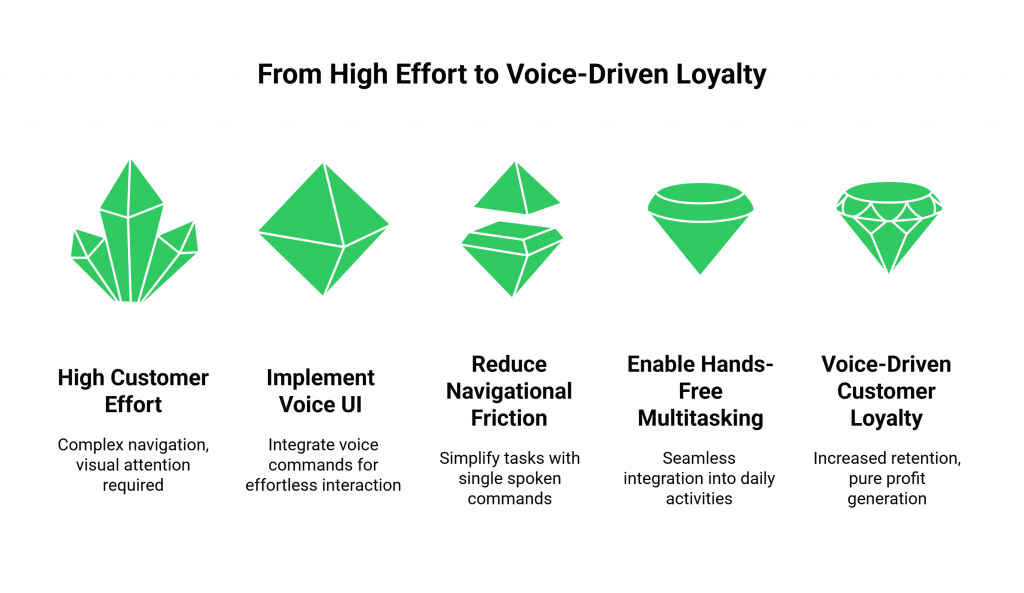
Loyal, repeat customers are the foundation of any healthy business. The key to creating them is to build an experience that is not just functional, but also effortless and emotionally resonant. This is where the unique strengths of a voice user interface come into play.
How Does a Voice User Interface Reduce Customer Effort?
The number one enemy of customer loyalty is effort. The more “work” a customer has to do to get an answer or solve a problem, the more likely they are to become frustrated and leave. A voice user interface is the ultimate effort-reducer.
How Does It Eliminate Navigational Friction?
Think about your website or app. To perform a task, a user has to visually locate the right menu, click through a series of pages, and apply the correct filters. This is a cognitive puzzle they have to solve. A VUI replaces this entire puzzle with a single, natural action: speaking.
- Instead of: Click “Products” -> Click “Men’s Apparel” -> Click “Jackets” -> Filter by “Waterproof” -> Filter by “Size: Large”
- A VUI allows: “Show me waterproof jackets in a size large.”
This collapsing of complex, multi-step workflows into a single spoken command is the most powerful way to reduce customer effort. A recent HubSpot report found that 90% of customers rate an “immediate” response as important or very important, and a voice command is the most immediate way to get a result.
How Does It Empower “Hands-Free” Multitasking?
The modern customer is a master of multitasking. They might be trying to get support while cooking, driving, or working out. A screen-based interface demands their full visual attention, forcing them to stop what they are doing. A voice user interface integrates seamlessly into their life, allowing them to get help without pressing pause on their day. This level of convenience is a powerful and memorable differentiator that shows you respect their time.
Also Read: How To Integrate Tool Calling Into Voice Conversations?
How Can a Voice User Interface Forge a Stronger Emotional Connection?
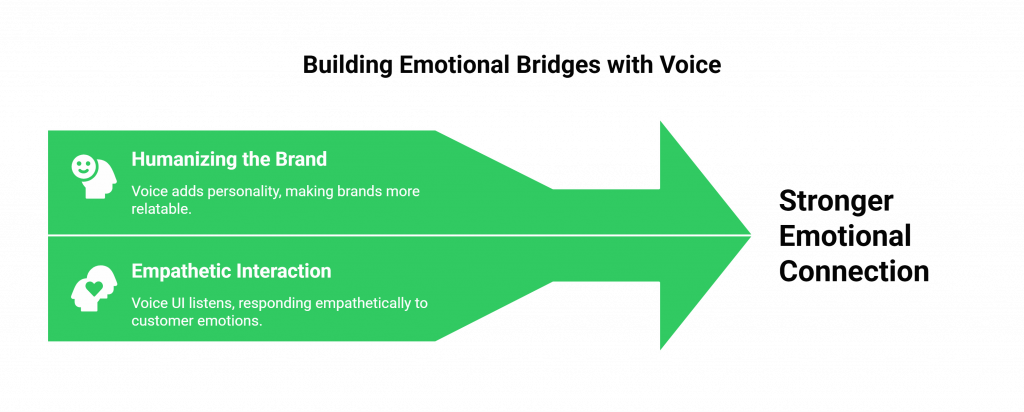
Customer loyalty is not just a rational calculation; it’s an emotional bond. A voice user interface, when designed correctly, is a uniquely powerful tool for building this emotional connection.
How Does a Voice Humanize Your Brand?
The human voice is a deeply personal and emotive instrument. A silent, text-based interface is inherently cold and impersonal. By giving your brand a voice, a carefully chosen, warm, and empathetic voice, you can transform a sterile transaction into a human-like interaction. This “sonic brand” becomes the audible personality of your company, and a positive, friendly voice can build a level of rapport and trust that plain text never can.
How Does a Voice Enable a More Empathetic Interaction?
A truly advanced VUI doesn’t just speak; it listens. By integrating sentiment analysis, the AI can detect the emotional state of the user from the tone of their voice.
- Scenario: A customer calls, and their voice is tight with frustration.
- A Bad Bot: “How can I help you today?” (in a cheerful, tone-deaf voice).
- A Good VUI: “It sounds like you’re having a frustrating day. I’m sorry to hear that. Let’s see if we can get this sorted out for you right away.”
This ability to recognize and respond to emotion is a profound way to de-escalate negative situations and make customers feel heard and understood, which is a cornerstone of retention.
Also Read: How To Scale Voice Agents For Millions Of Calls?
What is the Role of Infrastructure in a High-Quality Voice User Interface?
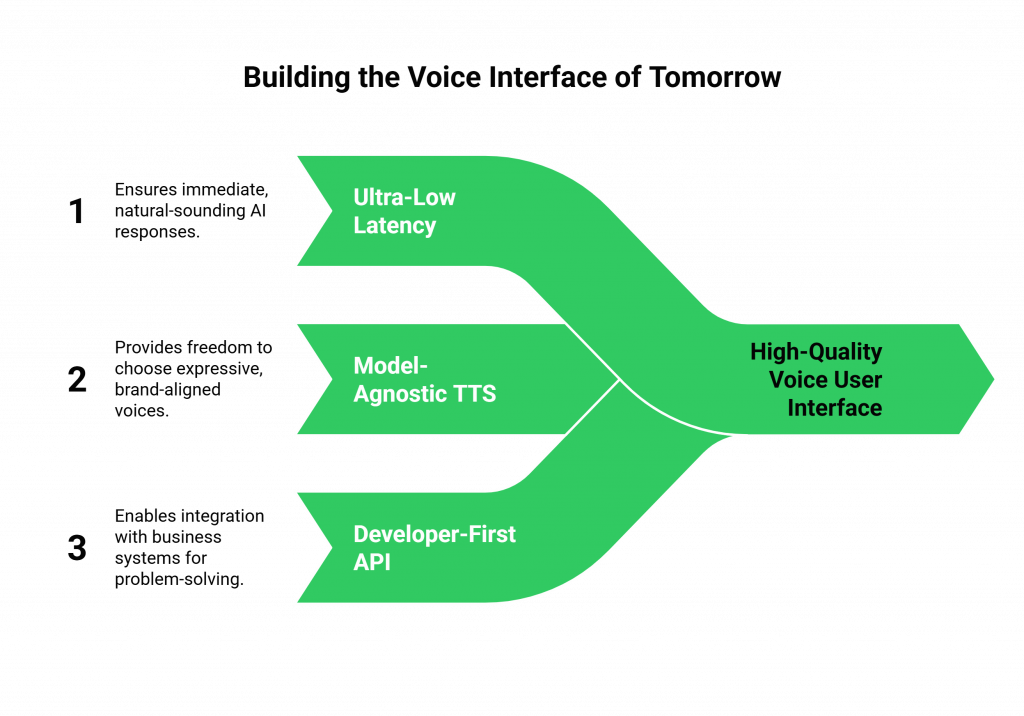
The most brilliantly designed, empathetic conversation will be completely ruined if the technology can’t keep up. The user experience of a VUI is directly and mercilessly tied to its technical performance. This is where the underlying voice infrastructure becomes the make-or-break component.
This is the specialized role of a platform like FreJun AI. Our philosophy is simple: “We handle the complex voice infrastructure so you can focus on your AI.”
- The Foundation of Rhythm: A human-like conversation depends on a natural rhythm. The latency, the delay between when a user stops speaking and the AI responds, must be incredibly low. A laggy VUI feels unintelligent and frustrating. FreJun AI’s entire global network is obsessively engineered for ultra-low latency, providing the high-speed “nervous system” that a natural-sounding voice user interface requires.
- The Canvas for Your Voice: A great VUI needs the perfect voice. We are a model-agnostic platform. This gives you the complete freedom to choose the absolute best, most expressive Text-to-Speech (TTS) engine from any provider on the market. We don’t lock you into a generic, robotic voice; we give you the canvas to paint your perfect sonic brand.
- The Power to Connect: A VUI is most powerful when it can take action. Our powerful, developer-first API gives you the granular control you need to connect your voice interface to your core business systems, allowing it to do more than just talk, but to actually solve problems.
Ready to build a voice experience that creates lifelong customers? Sign up for a FreJun AI developer account and explore our API.
What is the Long-Term Business Case for a Voice-First Retention Strategy?
Investing in a voice user interface is not a short-term tactic; it’s a long-term strategy for building a more resilient, customer-centric business. A voice-first approach creates a virtuous cycle.
- Reduced Effort -> Higher Satisfaction: By making it easier for customers to get help, you increase their satisfaction with every interaction.
- Higher Satisfaction -> Increased Loyalty: Happy, satisfied customers are far more likely to remain loyal to your brand.
- Increased Loyalty -> Higher Lifetime Value: Loyal customers spend more, more often, and are less expensive to serve, directly boosting your profitability.
- Voice Data -> Deeper Insights: Every voice interaction is a source of rich, unstructured data. By analyzing these conversations, you can gain deep insights into your customers’ pain points and desires, allowing you to continuously improve your products and services, which further drives satisfaction.
Also Read: Voice Interface UX Mistakes Businesses Should Avoid
Conclusion
In the final analysis, customer retention is about the quality of the relationship you build with your customers. A voice user interface is one of the most powerful tools available for strengthening that relationship. It creates an experience that is faster, more convenient, more personal, and more empathetic.
It’s about demonstrating to your customers, in every single interaction, that you value their time and you are there to help. By investing in a high-quality voice experience, you are not just building a new feature; you are building a foundation for lasting customer loyalty.
Want to see how a high-performance voice infrastructure can elevate your customer experience? Schedule a call with the FreJun Teler team to see a live demo.
Also Read: What Is Click to Call and How Does It Simplify Business Communication?
Frequently Asked Questions (FAQs)
A voice user interface (VUI) is a system that allows people to interact with a computer or device using their voice. Instead of using a screen, keyboard, or mouse, the user can speak commands and listen to spoken responses.
It improves retention by creating a better customer experience. It reduces the effort required to get help, provides instant 24/7 support, and can create a stronger, more personal emotional connection with the brand, all of which are key drivers of customer loyalty.
An IVR (Interactive Voice Response) is a rigid, touch-tone menu system (“Press 1…”). A modern VUI uses Natural Language Processing (NLP) to understand a user’s spoken words in their own language, allowing for a much more natural and flexible conversation.
CES is a key customer experience metric that measures how much effort a customer had to expend to get their issue resolved. A voice user interface is a powerful tool for lowering CES by making it faster and easier to get help.
It humanizes a brand by giving it a “sonic brand”—a unique, recognizable voice. A carefully chosen, warm, and expressive Text-to-Speech (TTS) voice can make the brand feel more personal and build a stronger emotional connection than silent text.
The most important technical factor is low latency. The delay between when a user stops speaking and the AI responds must be incredibly short (ideally under a second) for the conversation to feel natural and not frustrating.
Yes. An advanced VUI can use sentiment analysis to detect the emotional tone in a user’s voice. This allows it to respond with more empathy, for example, by acknowledging a user’s frustration.
A model-agnostic platform, like FreJun AI, is not tied to a specific AI provider. It gives you the freedom to choose your own “best-of-breed” STT, LLM, and TTS models, which is crucial for crafting the perfect voice and intelligence for your VUI.
Yes. A voice user interface can be deployed on multiple channels. It can act as an AI receptionist on your main phone line or as a voice-based assistant on your website or mobile app.
FreJun AI provides the essential, high-performance voice infrastructure. We provide the ultra-low-latency, real-time audio streaming that is the necessary foundation for a fast, responsive, and natural-sounding VUI, which is the key to a positive customer experience that drives retention.