
In the whirlwind of AI advancements, few projects captured the imagination quite like AutoGPT. It was a glimpse into a tantalizing future: an AI that did not just answer questions, but could autonomously pursue goals. You could give it a high-level objective, and it would create its own plan, search the web, and execute tasks to achieve it.
But this powerful, independent agent has one major limitation: it is trapped behind a command line, unable to interact with the world in the most human way possible, through voice.
How do you give this autonomous brain a voice to speak and ears to listen? How can a non-technical user delegate a complex task to AutoGPT with a simple phone call?
The answer is a critical piece of infrastructure that connects this advanced AI to the real world: a VoIP Calling API Integration for AutoGPT. This technology is the key to unlocking the true potential of autonomous agents, transforming them from a developer’s experiment into powerful, accessible applications.
Table of contents
- What is AutoGPT? The Dream of an Autonomous Agent
- The “Silent Oracle” Problem: Why AutoGPT Needs to Talk
- How Does the Integration Work Architecturally?
- Why is FreJun AI the Essential Voice Infrastructure for AutoGPT?
- How Does a VoIP Calling API Integration for AutoGPT Power Applications?
- Conclusion
- Frequently Asked Questions (FAQ)
What is AutoGPT? The Dream of an Autonomous Agent
To understand the integration’s impact, we must first appreciate what makes AutoGPT so revolutionary. Unlike a traditional chatbot that follows a request-response pattern, AutoGPT is an experimental, open-source application designed to be an autonomous agent. Key characteristics that set it apart include:
- Goal-Oriented: You do not give it a simple prompt; you give it a final goal (e.g., “Create a market analysis report for the EV industry in 2025”).
- Self-Prompting: It thinks for itself. It generates its own “thoughts,” “reasoning,” and a “plan” to reach the goal, breaking it down into smaller, actionable steps.
- Autonomous Tool Use: It can independently decide to use tools like a web browser for research, a file system to save information, or even execute code to perform calculations.
AutoGPT represents the “willpower” of an AI, the ability to act independently to achieve a goal. However, this powerful mind has no voice.
The “Silent Oracle” Problem: Why AutoGPT Needs to Talk
An autonomous agent that cannot communicate with the outside world is like an oracle that can only write its prophecies on a screen in an empty room. To make it truly useful, it needs a way to interact with people. Attempting to build this voice connection from scratch is a massive undertaking, filled with complex telecommunications challenges.
| Challenge | The DIY Telephony Method | The VoIP API Integration Method |
| Real-Time Interface | Requires building and managing a fragile, two-way audio streaming system. | A simple, managed WebSocket handles all real-time audio transport reliably. |
| Long-Running Tasks | A phone call must be kept stable for minutes while AutoGPT “thinks,” which is prone to failure. | Enterprise-grade infrastructure ensures a rock-solid connection for long-duration tasks. |
| Complexity | Forces AI developers to become telecom engineers, debugging SIP protocols and managing servers. | All telephony complexities are hidden behind a clean, developer-friendly API. |
| Focus | Diverts critical resources away from refining the AI’s goals and capabilities. | Allows developers to focus 100% on what makes their application unique: the AI’s autonomy. |
The DIY path is a dead end for most AI projects. It is a slow, expensive, and distracting process. A VoIP Calling API Integration for AutoGPT is the modern, efficient solution that bypasses
How Does the Integration Work Architecturally?
A VoIP Calling API acts as a managed communication layer, translating spoken words into data your AutoGPT application can understand, and vice-versa. Here is a high-level look at the process:
- The Call and the Goal: A user calls a phone number managed by the VoIP API platform. When prompted, they speak their high-level goal (e.g., “Plan a three-day, budget-friendly hiking trip in Colorado”).
- Voice to Text: The platform streams the user’s voice to your application server, where a Speech-to-Text (STT) engine transcribes it into text.
- AutoGPT is Activated: This transcribed goal is passed as the initial objective to your AutoGPT instance. The autonomous process begins.
- The Autonomous Loop: AutoGPT starts its “thought, reason, plan, critique” cycle. It might use its web search tool to find trails and budget-friendly lodging, its file system tool to save notes, and its reasoning capabilities to construct an itinerary. This can be a long-running process that takes several minutes.
- The Goal is Achieved: Once AutoGPT determines it has completed the task, it produces a final, comprehensive text output.
- Text to Voice: This final plan is sent to a Text-to-Speech (TTS) service to be converted into natural-sounding audio.
- The Solution is Delivered: The generated audio is streamed back to the caller via the VoIP API, providing them with a complete, AI-generated plan.
Also Read: Programmable Voice APIs Vs Cloud Telephony Compared
Why is FreJun AI the Essential Voice Infrastructure for AutoGPT?
You are working with a powerful, experimental AI. The infrastructure connecting it to the world must be exceptionally reliable. FreJun AI is not an AI agent framework; we are the specialized voice infrastructure that gives your autonomous AI a voice and ears.
Our mission is to support your most ambitious projects: “We handle the complex voice infrastructure so you can focus on building your AI.”
Here is why FreJun is the perfect partner for your AutoGPT application:
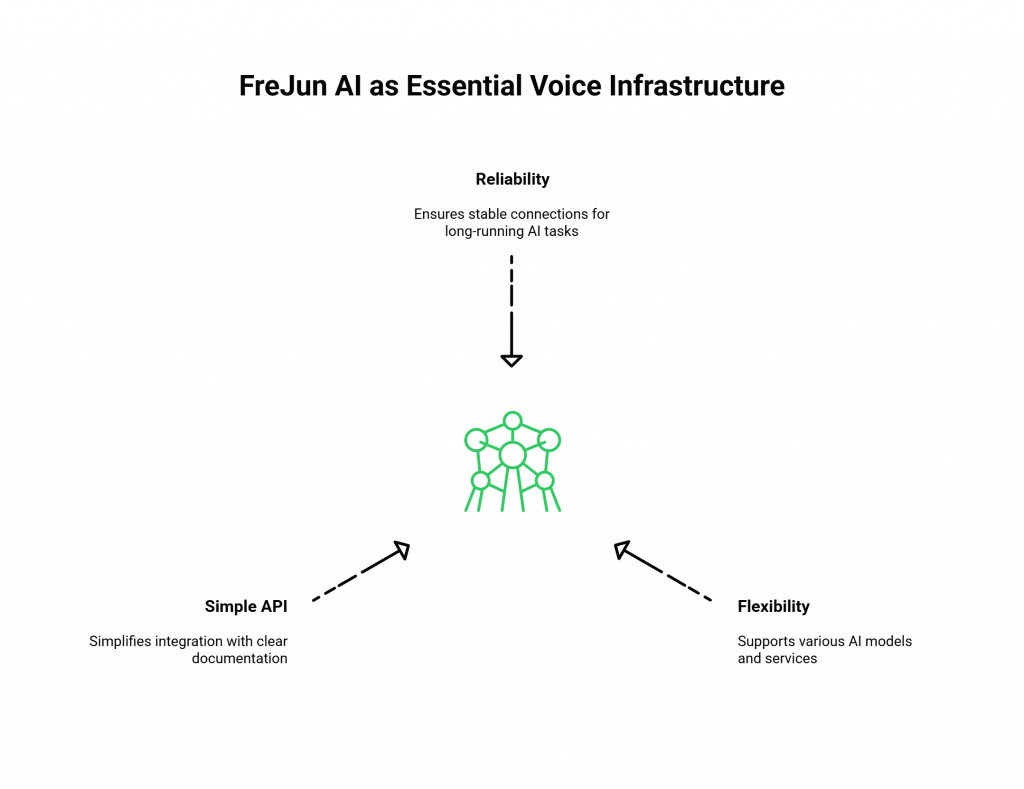
- Reliability for Long-Running Processes: This is the most critical factor. An AutoGPT task is not instantaneous. Our enterprise-grade infrastructure is designed to maintain a stable, active call connection for the extended duration required for the AI to “think” and work, preventing frustrating dropped calls.
- Flexibility for an Open-Source World: The spirit of AutoGPT is open-source freedom. Our model-agnostic platform aligns perfectly with this, allowing you to use any STT, LLM, or TTS service you choose. You control the entire AI stack.
- Simple API for a Complex Agent: The complexity should be in your AI’s logic, not its connection to the world. Our developer-first SDKs and clear documentation make integrating a voice channel a straightforward process. Ready to start building? Check out our developer documentation.
Must Read: How To Lower Latency In Voice AI Conversations?
How Does a VoIP Calling API Integration for AutoGPT Power Applications?
This integration does not just add a feature; it creates an entirely new category of AI applications.
It Creates Autonomous Voice for Researchers
A user can call a number, delegate a research task (“Find and summarize the latest clinical trials related to Alzheimer’s disease”), and receive a comprehensive, spoken summary. This turns every phone into a portal for on-demand, in-depth research.
You Can’t Miss: How VoIP Calling API Integration for ElevenLabs.io Improves AI Voice Apps?
It Enables Goal-Oriented Personal Assistants
Users can delegate real-world planning tasks. Imagine calling and saying, “Find three restaurants near me that are open late, have vegan options, and take reservations. Book a table for two at the best-rated one for 9 PM.” AutoGPT could use its tools to accomplish this entire sequence.
It Democratizes Access to Autonomous AI
This is the most powerful benefit. It takes AutoGPT out of the hands of developers and makes it accessible to anyone who can make a phone call. It allows non-technical users to leverage the power of autonomous agents to solve their problems.
Conclusion
AutoGPT represents a bold step towards the future of truly autonomous AI. It is a system that can reason, plan, and act to achieve goals. However, without a voice, its power is limited to those who can interact with it through a keyboard.
A VoIP Calling API Integration for AutoGPT is the essential technology that shatters this limitation. It gives your autonomous agent a voice and ears, connecting it to the world and making its powerful capabilities accessible to everyone.
By partnering with a dedicated voice infrastructure provider like FreJun, developers can offload the immense complexity of telecommunications and focus on the exciting challenge of building the next generation of autonomous AI applications. You build the mind; we provide the connection that lets it speak.
Also Read: How Business Expansion Is Fueled by a Smart Call System in Saudi Arabia
Frequently Asked Questions (FAQ)
AutoGPT is an experimental, open-source application that uses a Large Language Model (LLM) to achieve a high-level goal autonomously. It can break down goals into smaller tasks and use tools like a web browser to complete them.
No. AutoGPT is a framework for AI logic and autonomous tasking. It does not have the built-in telecommunications infrastructure needed to connect to the global telephone network. A VoIP Calling API provides this missing piece.
The primary challenge is managing a live, real-time phone call while a potentially long-running, asynchronous AI process (AutoGPT’s thinking loop) is executing in the background. This requires a highly reliable voice infrastructure that can keep the call stable for an extended period.
A standard chatbot is reactive; it responds to a specific prompt. An AutoGPT-powered voice agent is proactive and goal-oriented. You give it a final objective, and it independently works to achieve it, making for a much more powerful and capable interaction.
No, they are complementary technologies. AutoGPT provides the autonomous AI “brain.” FreJun provides the voice infrastructure, the “voice and ears,” that connects that brain to the real world via the telephone network.