
In today’s hyper-connected world, a voice call is no longer just a simple conversation between two people. It is a dynamic, data-rich, and often automated interaction that lies at the heart of the customer experience. From an AI agent that can instantly answer a customer’s question to a seamless, in-app call that provides real-time support, voice has evolved into a fully programmable channel for engagement.
But to build these modern voice experiences, businesses and their developers need more than just a connection to the phone network. They need a powerful and flexible set of building blocks. They need the best voice API for business communications.
Choosing a voice API is a critical strategic decision. The right platform can act as a powerful catalyst for innovation, enabling you to build faster, scale smarter, and deliver a superior customer experience. The wrong one can become a bottleneck, saddling you with poor call quality, limited functionality, and a frustrating developer experience. But in a crowded market, what truly separates the best from the rest?
It comes down to a specific set of core features that are non-negotiable for any modern, production-grade voice application. This guide will break down the 10 essential features that define the best voice API for business communications.
Table of contents
- 1. Uncompromising Voice Quality and Ultra-Low Latency
- 2. A Truly Developer-First Experience
- 3. Global Reach with Local Presence
- 4. Unmatched Reliability and Scalability
- 5. Deep, Programmable Control Over Real-Time Media
- 6. A Flexible, Model-Agnostic Approach to AI
- 7. Robust Security and Compliance by Design
- 8. Powerful Analytics and Observability
- 9. Seamless API Integration Ease
- 10. Transparent and Predictable Pricing
- Conclusion
- Frequently Asked Questions (FAQs)
1. Uncompromising Voice Quality and Ultra-Low Latency
This is the absolute, foundational requirement. If the calls do not sound good, nothing else matters. In the world of voice, quality is defined by two key metrics:
- Clarity: The audio must be crystal clear and free of jitter, packet loss, and other artifacts that make it sound garbled or choppy. This requires a provider with a carrier-grade network and deep, direct connections to Tier-1 carriers.
- Latency: This is the delay in the conversation. For real-time streaming voice and AI applications, latency is the arch-nemesis. A voice quality and latency problem is the fastest way to create a frustrating user experience. The best voice API for business communications is built on a globally distributed, edge-native infrastructure that processes calls at a location physically close to the end-user to minimize this delay.
2. A Truly Developer-First Experience
A modern voice API is a tool for software developers. As such, it must be designed with their needs as the absolute top priority. This goes far beyond just having an API.
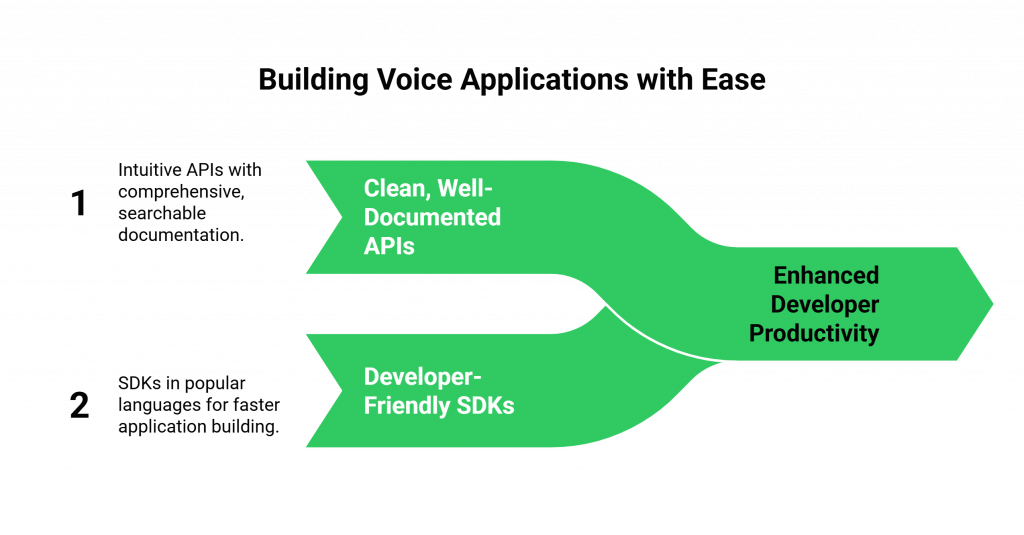
Clean, Well-Documented APIs
The API itself must be logical, consistent, and intuitive. But the API is only as good as its documentation. The documentation should be comprehensive, easy to search, and filled with practical code examples that help a developer go from zero to “hello world” in minutes, not days.
A Rich Ecosystem of Developer-Friendly SDKs
While a direct API is essential, developer-friendly SDKs (Software Development Kits) in popular languages like Python, JavaScript, Java, and C# are a massive accelerator. These SDKs handle the low-level HTTP requests and authentication, allowing developers to work with high-level, native language objects and build their applications much faster.
Also Read: From MCP to AgentKit: How to Deploy Voice-Enabled LLM Agents with Teler
3. Global Reach with Local Presence
Business is global, and your voice infrastructure must be too. This means more than just being able to call other countries. The best voice API for business communications provides:
- A Global Phone Number Inventory: The ability to instantly provision local, national, and toll-free numbers in dozens of countries around the world via an API.
- Guaranteed Regulatory Compliance: The provider must handle the complex and ever-changing telecom regulations in each country, ensuring that your calls are always compliant with local laws.
- Localized Calling: The ability to present a local caller ID when making outbound calls, which dramatically increases answer rates.
4. Unmatched Reliability and Scalability
A business communication platform is a mission-critical service. It has to work, every single time, and it has to be able to handle your busiest day without breaking a sweat.
- Carrier-Grade Uptime: Look for a provider that offers a financially backed Service Level Agreement (SLA) of 99.99% or higher. This is a clear indicator of their confidence in their infrastructure’s reliability.
- Elastic Scalability: The platform must be truly elastic, allowing you to scale from one to tens of thousands of simultaneous calls in an instant without any manual intervention. This is essential for handling unpredictable call spikes or large-scale AI-driven campaigns. One study on business continuity highlighted that downtime can cost a business an average of $5,600 per minute, making this level of reliability a non-negotiable requirement.
5. Deep, Programmable Control Over Real-Time Media
For AI applications, this is the most critical feature. The best voice API for business communications does not just connect a call; it gives you the power to interact with the raw audio stream in real-time. This capability, often called real-time streaming voice, allows you to:
- Fork the Media Stream: Programmatically create a live copy of the call’s audio and send it to your AI’s Speech-to-Text engine.
- Inject Audio: Send your AI’s synthesized audio response back into the live call.
- Analyze the Stream: Perform real-time analysis on the audio for things like sentiment analysis or voice biometrics.
This is the core capability that enables a truly interactive and intelligent voice agent.
Also Read: Voice Recognition API: Enabling Smarter Voice-Based Applications
6. A Flexible, Model-Agnostic Approach to AI
The world of AI is moving at a breakneck pace. The best LLM today might be replaced by a better one tomorrow. A voice API provider that locks you into their own proprietary AI models is a major strategic risk. A key indicator of the best voice API for business communications is a model-agnostic philosophy. The platform should be designed to be the “voice” for any AI “brain” you choose, giving you the freedom to integrate with the best-in-class models from any provider, like OpenAI, Google, or Anthropic.
7. Robust Security and Compliance by Design
Voice communication often involves sensitive data, from personal information to financial details. Security cannot be an afterthought; it must be built into the very fabric of the platform.
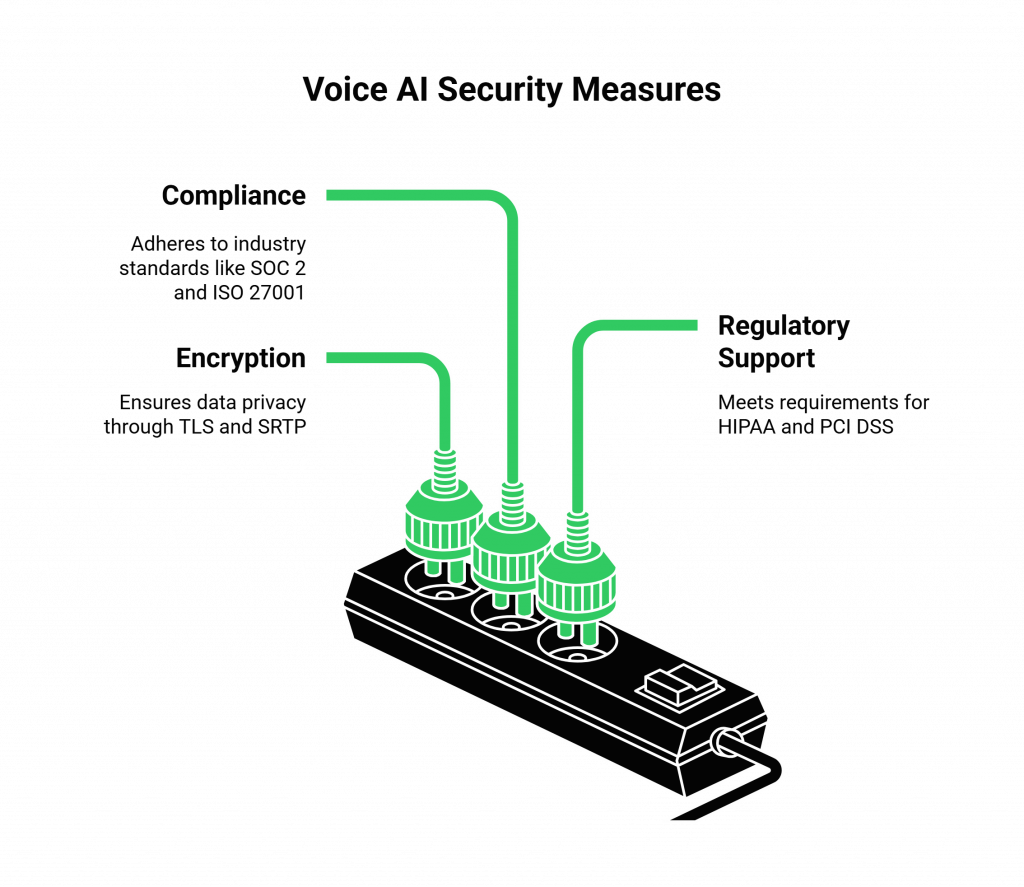
- Encryption: The platform must support end-to-end encryption, using Transport Layer Security (TLS) for the signaling and the Secure Real-time Transport Protocol (SRTP) for the media.
- Compliance Certifications: Look for a provider that can demonstrate compliance with key industry standards like SOC 2, ISO 27001, and can support the requirements for regulations like HIPAA and PCI DSS.
8. Powerful Analytics and Observability
You cannot manage what you cannot measure. A modern voice API must provide deep, real-time visibility into every aspect of your voice traffic. This includes:
- Detailed Call Detail Records (CDRs): Granular, API-accessible logs for every single call.
- Real-Time Dashboards: A visual interface for monitoring call quality, usage, and costs.
- Webhook Eventing: Real-time notifications for every event in a call’s lifecycle, which is essential for debugging and building resilient applications.
9. Seamless API Integration Ease
The ease of integration is a direct measure of a platform’s developer-centricity. The API integration ease is determined by several factors:
- A Clear and Logical API Design: The API should be RESTful, predictable, and follow modern design conventions.
- Interactive API Explorers: Tools that allow a developer to make live API calls directly from the documentation page.
- “Hello World” in Minutes: A new developer should be able to sign up, get an API key, provision a number, and make their first successful API-driven call in under 30 minutes.
Ready to experience a platform that was built on these ten core principles? Sign up for FreJun AI and get your API keys to see the difference for yourself.
Also Read: What Is Real-Time Media Streaming and Why It Matters for Voice AI
10. Transparent and Predictable Pricing
Finally, the business model must be as transparent and flexible as the technology. The best voice API for business communications offers a simple, pay-as-you-go pricing model with no complex contracts, no upfront commitments, and no hidden fees. The pricing should be easy to understand and should allow you to accurately forecast your costs as your usage scales.
This table provides a quick checklist of these 10 essential features.
| Feature Category | Essential Capability | Why It Matters for Modern Business |
| Performance | Uncompromising Voice Quality and Ultra-Low Latency | Ensures a professional and natural-sounding user experience. |
| Developer Experience | A Truly Developer-First Experience (APIs & SDKs) | Accelerates development time and enables innovation. |
| Global Operations | Global Reach with Local Presence | Allows your business to scale and operate globally with a local feel. |
| Infrastructure | Unmatched Reliability and Scalability | Guarantees your communication is always on and can handle any demand. |
| AI Enablement | Deep, Programmable Control Over Real-Time Media | The non-negotiable requirement for building interactive voice AI. |
| Flexibility | A Flexible, Model-Agnostic Approach to AI | Future-proofs your investment and gives you the freedom to innovate. |
| Security | Robust Security and Compliance by Design | Protects your sensitive data and builds customer trust. |
| Visibility | Powerful Analytics and Observability | Provides the data you need to manage, debug, and optimize your system. |
| Integration | Seamless API Integration Ease | Drastically reduces the time and effort required to get started. |
| Business Model | Transparent and Predictable Pricing | Aligns your costs directly with your usage and eliminates waste. |
Conclusion
The search for the best voice API for business communications is a search for a true technology partner. It is about finding a platform that not only provides a reliable and scalable connection to the global voice network but also shares a deep, philosophical commitment to empowering developers and enabling innovation.
The ten features outlined above are not just a list of technical specifications; they are a manifesto for what a modern voice infrastructure should be. By choosing a platform that is built on these core principles, you are not just buying a service; you are investing in a foundation that will power your customer communications for years to come.
Want to see how the FreJun AI platform stacks up against these 10 essential features? Schedule a personalized demo with FreJun Teler.
Also Read: The Complete Guide to Virtual Numbers: Benefits, Uses, and Setup
Frequently Asked Questions (FAQs)
It is a set of programming tools that allows developers to embed voice communication features, like making and receiving phone calls, building AI agents, and managing call flows, directly into their own business applications.
Poor voice quality and latency create a frustrating and unprofessional user experience. For an AI agent, high latency makes the conversation feel unnatural and robotic, defeating its purpose.
Developer-friendly SDKs are pre-built software libraries in various programming languages that simplify the process of interacting with the voice API, allowing developers to build their applications faster.
Real-time streaming voice refers to the capability of the API to provide a live, real-time copy of the call’s audio stream to an application. This is the essential feature that allows an AI to “hear” the caller.
By having servers around the world, the platform can handle a call at a location physically closer to the end-user. This reduces the data’s travel time across the internet, which is the most effective way to lower latency.
It means the platform is not tied to any single AI provider. You are free to bring your own Speech-to-Text (STT), Large Language Model (LLM), and Text-to-Speech (TTS) models from any vendor, giving you maximum flexibility.
The API integration ease is a direct measure of how quickly your development team can start delivering value. A platform with a clear API and great documentation can turn a month-long project into a week-long one.
At a minimum, the platform must support TLS for encrypting the call signaling and SRTP for encrypting the voice media itself.
It aligns your costs directly with your usage. You never pay for idle capacity, which is a much more efficient and predictable model, especially for businesses with variable or growing call volumes.